
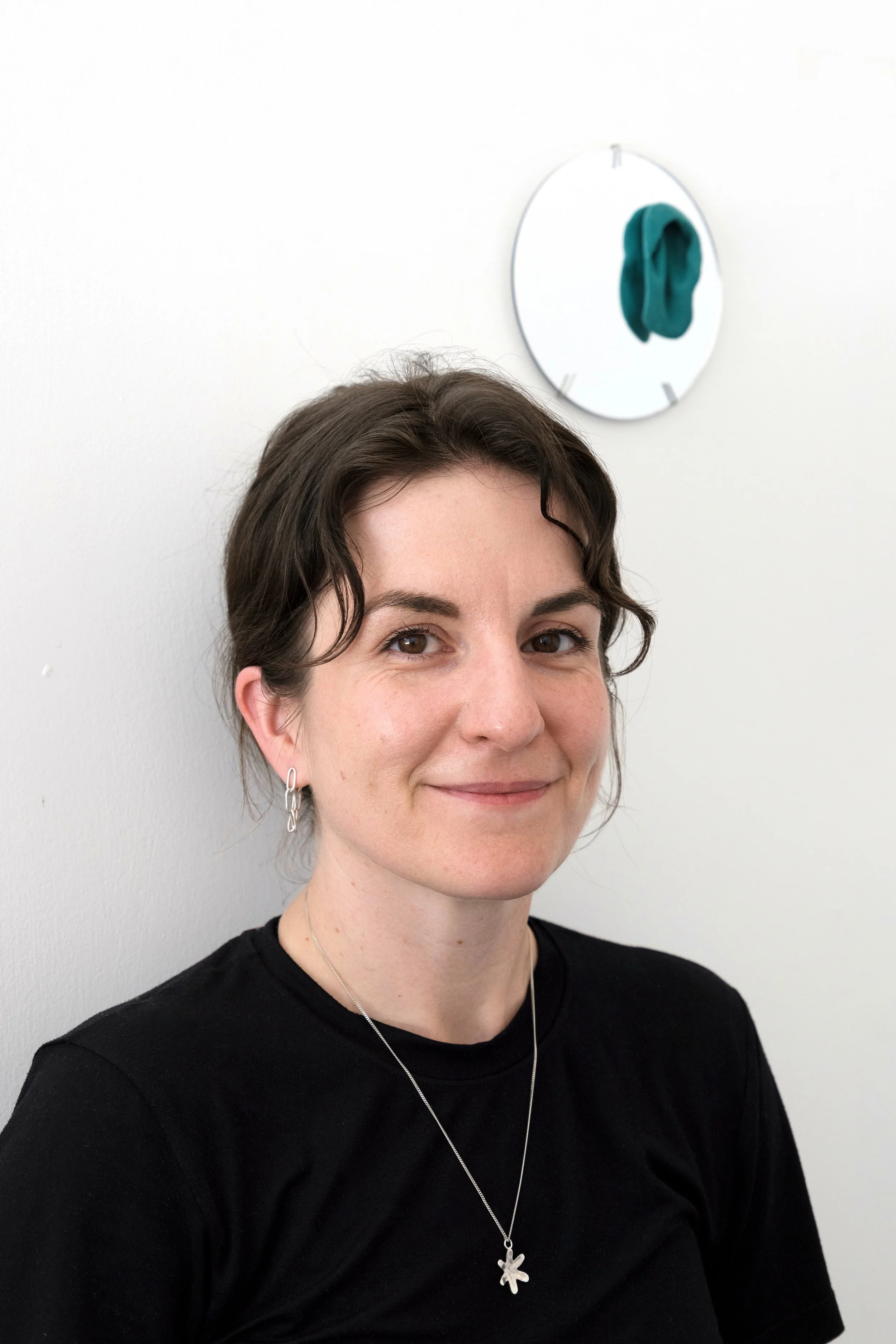
Photography by Dean Quilin Li.
Lois Waters
Lois Waters is a hard of hearing artist who uses textile processes to visualise her experience of sound. She is interested in what materials can and can’t do, as a parallel for the limits and possibilities of the body. Undulating, dissolving or bent and strange, her work uses abstraction to investigate how materials of the body can transform to generate new sensory experiences.
Waters was born in Melbourne, and currently lives on Gadigal Wangal land in Sydney’s inner-west. She is a board member at Tiles Lewisham, and previously worked as a printmaking technician at the University of Melbourne. She has recently participated in collaborative projects in printmaking, textiles and sound at PCA Gallery (VIC), Sawtooth ARI (TAS), Bundanon AIR (NSW) and Puzzle Gallery (NSW). In 2025 she was awarded the Burnie Print Prize, and was also a finalist in the Walyalup Fremantle Arts Centre Print Award, the Firestation Monoprint Prize, and the Bayside Painting Prize.
Lois Waters, Bend, 2025, found fabric, cotton thread, stainless steel, 32 x 14.5 x 7 cm. Image courtesy of the artist.
Lois Waters, installation view from Eight ways to peel an orange, 2025, Puzzle Gallery, Chippendale. Photography by Dean Quinlin Li.
Tell us about your creative process. What drives your practice?
I love making because it's an opportunity to operate in a non-linear way, and form associations between seemingly disparate things. I tend to go on multiple tangents simultaneously, abandon the majority, and then pick them all up again at different times with renewed enthusiasm. It’s important that making feels relaxing and exploratory, so I lean into this way of making rather than fighting it.
I trained as a printmaker, so this loose approach is balanced by a firm interest in techniques, methods and guiding rules. When I'm moving between different media, I allow elements of each to inform the other. Over time I’m slowly building an understanding of how materials behave/misbehave, and thinking about how this is mirrored in the materials of the body.
How do your material choices inform your explorations into sensory experience?
Textiles have been a very consistent element in my practice, I think because they have such a close relationship with the body. The technologies associated with textile production also speak to a desire to extend or modify the body. Working with textiles allows me to talk about the body while still using the language of abstraction, and consider the form and function of the body in an expanded way.
I tend to select materials that suggest or simulate the body in some way, creating forms that imply suspended actions, expansion and collapse. I purposefully create ambiguous images and forms, and resist assigning them a positive or negative value. I think this is an attempt to reflect my altered experience of sound, and the shifts in my identity as a result. It can be difficult to discuss this experience in words without accidental negative framing, due to the strong influence of the medical model on written language. I can more reliably simulate my experience through image and form-making. The visual language of textiles feels particularly flexible, and capable of holding contradictions.
Earlier this year I also joined Kate Brown, Laurence Quinn, Angie Garrick and Matthew Gorgula at the Bundanon Artist in Residence program, where we started to collaborate as part of a new art/music collective. Working with sound more directly as a hard of hearing person has really expanded how I think about sensory experience. Everyone in the group brings such a depth of experience in their own practice, and an equal openness to different possibilities.
Lois Waters, Warp 4, 2025, etching ink on kozo paper on board, 30 x 20.8 x 2.2 cm. Photography by Brenton Smith.
Lois Waters, Warp 6, 2025, etching ink on kozo paper on board, 30 x 20.8 x 2.2 cm. Photography by Brenton Smith.
What draws you to using textiles as a printing matrix?
I originally started playing around with textile plates as a way to emulate the qualities of aquatint and softground. I was interested in how I could produce the fineness and subtlety of these processes with more accessible materials.
I think I've continued working with textiles because every time I print, the process generates a new idea. With the inherent variation of second-hand fabrics, I don't think I'll ever really leave the trouble-shooting phase. This is my favourite part of printmaking, where I'm actively learning about how materials behave and interact.
I also love the focus printing in this way brings. There's a lot of decision-making and judgement involved at each stage of the printing process. To get the right contrast, texture and feeling from each plate, you have to get your ink colour, application and press pressure just right. What works for one plate will yield opposite results for another, so you have to really pay attention to and try to understand the material you're using. What's needed depends on the weight of the fabric, the openness of the weave, whether it is folded with or against the grain, the paper you're using to print, the press blankets and the backing materials in the press. You have to be analytical, but also responsive and move with the material.
How has beading expanded your practice?
I first found beading satisfying because you’re bringing together all of these tiny disparate parts into something solid and coherent. The first beaded object I made was Drape (2024), where I used bead-netting to create drapery. I then started playing with the idea of making beaded sculptural objects that felt incoherent or strange, and ended up Drop (2024). There’s a certain seriousness to a beaded object, because of the amount of time you invest in making it. With something like Drop you’re then asking the audience to spend a lot of time looking at an almost-familiar tube that sits somewhere between a shower tap, a string phone, and a secret third thing.
Working with beading has been interesting. Although it sits within textiles, the process feels a lot like drawing. The beaded works I’ve made are all off-loom, so the structure is made with a single thread that loops back on itself. Beading in this way is like drawing, but you can't lift your pencil off the paper. You have to be quite decisive too, because you can only move in one direction.
Thinking about beading in this way made me realise that I’d been missing drawing, so I started doing watercolour and graphite drawings that resembled bead structures. At the moment I think I prefer drawing, because you can make more freely. Beading feels a lot like how I move between different ideas when I’m making - I loop back on myself, and the unifying structure appears much later.
Lois Waters, Leech and Dissolve, 2024, glass beads, fireline thread, stainless steel, dimensions variable. Photography by David Suyasa.
Lois Waters, Net with wave, 2025, watercolour and graphite on board , 15 x 15 x 2.2cm. Image courtesy of the artist.
Are there any printmakers | artists that influence you?
I tend to gravitate towards non-figurative work that generates a certain feeling or state in the body. Agnes Martin, Hilarie Mais and Kim Lim come to mind for the intention and clarity in their work. I’ve also been thinking a lot about the statement necklace and brooch Theo Fennel made from Elton John’s kneecaps, and other ways we might disguise or celebrate our retired components.
In printmaking, I’m always in awe of artists and master printers who successfully bring different techniques together in a singular image. I make a yearly pilgrimage to the NGA to see the Ken Tyler Collection, and regularly come back to Sandro Chia and David Hockney’s prints. I love the way they both combine etching and lithography to produce specific effects, and how successive layers of ink interact so purposefully. These are textures and surface qualities that only printmaking can produce. You can really play with and refine how the media sits in relation to the surface.
Finally, what exciting projects are you working on at the moment?
For the last year I've been collecting diagrams, and they're leading me towards something new. So far my favourites are: a medical textbook that demonstrates how humans are unlike horses; sheet music that illustrates waltz footwork; and a self-help book that visualises factory reporting lines in the most convoluted way possible. I think they appeal to me because they’re another way of abstracting and dissecting the body. They’re intended to create clarity, but are so often confounding or completely meaningless.
I started collecting them while making Swell for Sawtooth ARI. I was thinking then about diagrams, mapping and imaging as a way of dissolving a place or body into discrete elements. This is at odds with the way I usually use abstraction, where I’m trying to give momentary shape to something internal that feels unfixed. I’m looking forward to revisiting this idea and playing with abstraction in a new way.